The summer of 1816 barely happened. A year earlier, the Indonesian volcano Tambora had exploded in one of the largest eruptions in recorded history, throwing so much ash into the sky that Europe went cold and wet. People later called 1816 "the Year Without a Summer."
On the shore of Lake Geneva, a small group of young English writers were stuck indoors at the Villa Diodati: the poet Lord Byron, his doctor John Polidori, the poet Percy Shelley, and Percy's partner, 18 year old Mary Godwin. One night, after reading German ghost stories aloud, Byron proposed a contest: each of them would write a ghost story. Byron and Shelley soon gave up. Polidori wrote The Vampyre, one of the first vampire tales in English. Mary wrote Frankenstein.
What you're reading
A novel about Victor Frankenstein, a brilliant young Swiss student who discovers how to give life to dead matter. He builds a man about eight feet tall from parts, brings him to life, and is so horrified by what he sees that he runs away. The creature, abandoned and rejected by everyone who sees him, teaches himself to speak and read, and slowly turns his loneliness into revenge on his maker.
What makes it special
The monster is not called Frankenstein. Frankenstein is the scientist. The creature never gets a name; Victor calls him "wretch," "fiend," "daemon." The fact that the world gave the creator's name to the creation is a small irony the book would have appreciated.
The creature can talk, and he argues well. Forget the grunting giant of the movies. Shelley's creature reads Paradise Lost and Plutarch, and makes his case in long, eloquent speeches. His most famous line sums up the whole book: "I was benevolent and good; misery made me a fiend."
It is a story about science, not magic. Earlier horror relied on ghosts and curses. Victor uses chemistry, anatomy, and electricity, the cutting edge science of Shelley's time. That is why the critic Brian Aldiss argued in 1973 that Frankenstein is the first true science fiction novel, a claim many scholars still accept.
The story behind it
Frankenstein was published anonymously on 1 January 1818, in three small volumes. Because Percy Shelley wrote the preface, many reviewers assumed he was the author. Mary's name first appeared on the title page of the second edition, in 1823.
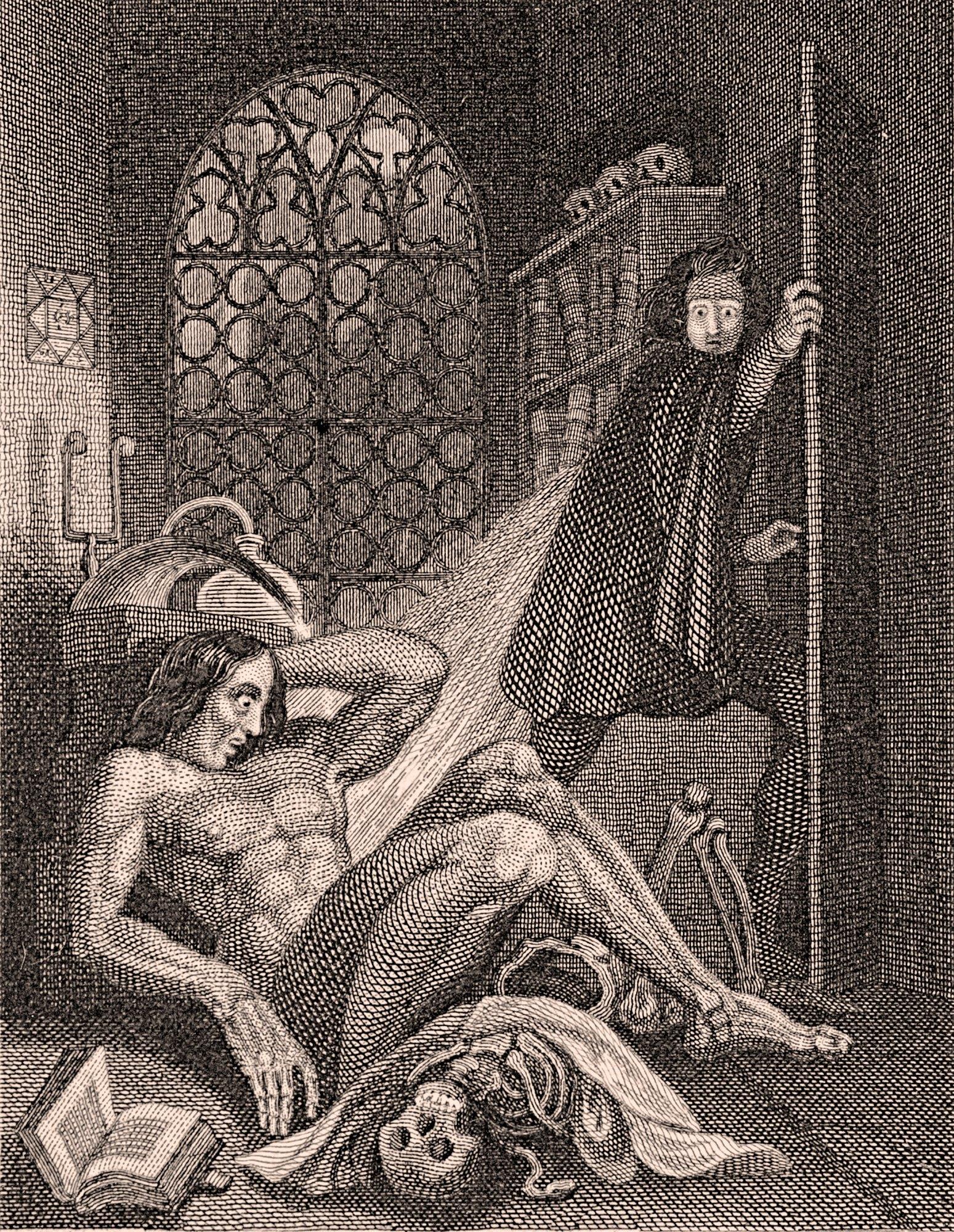
In 1831 she revised the novel and added an introduction telling how the idea came to her: lying awake one night, she saw in her mind a "pale student of unhallowed arts" kneeling beside the thing he had put together. That 1831 edition also carried the engraving shown above, the first ever illustration of the creature, sitting up as Victor flees through the door.
One detail most people miss
The novel does not open in a laboratory. It opens in the Arctic, with letters from an ambitious explorer, Robert Walton, whose ship is trapped in ice while he hunts for a passage to the North Pole. He rescues a half frozen stranger from the ice: Victor Frankenstein. Walton is Victor's mirror image, another young man ready to risk everything for discovery, and the whole story is told to him as a warning. Whether he listens is the book's final question.
How to read it
Frankenstein is in the public domain. You can read it free on Project Gutenberg or Standard Ebooks, and LibriVox has free audiobook versions. Most modern editions follow either the 1818 text or the revised 1831 text; the 1831 version includes Shelley's introduction about that night by the lake, which is worth reading first. It runs around 75,000 words, about the length of a long weekend.