Shakespeare's lovers meet on a Sunday night and are dead by Thursday morning. They fall in love in about fourteen lines, marry the next afternoon, spend one night together, and are buried before the week is out. In the long English poem Shakespeare took the plot from, Arthur Brooke's Romeus and Juliet of 1562, the affair lasted about nine months. Shakespeare squeezed it to four days, and that compression is the engine of the play. Everything happens too fast for anyone to think.
He also made Juliet younger. Brooke's heroine was sixteen. Shakespeare's is "not fourteen," two weeks short of her fourteenth birthday, which her father and nurse discuss at length. Romeo's age is never given. The play is, among other things, about what happens when adults treat children's feelings as a problem to be managed.
What you're reading
A tragedy in five acts, written around 1595 and first printed in 1597. In Verona, two families, the Montagues and the Capulets, have been feuding for so long nobody remembers why. Romeo, a Montague, crashes a Capulet party in a mask and meets Juliet. They marry in secret with the help of Friar Laurence. Within hours Romeo kills Juliet's cousin Tybalt in a street fight and is banished. Juliet's parents arrange to marry her to a count. The Friar gives her a potion that will make her seem dead for 42 hours so she can escape. The letter explaining the plan never reaches Romeo. He finds her in the tomb, believes she is dead, and drinks poison. She wakes, finds him, and stabs herself. The families reconcile over the bodies.
What makes it special
The lovers speak in a different language from everyone else. The play opens with servants making dirty jokes and ends with a prince making a speech. In between, whenever Romeo and Juliet are alone, the verse lifts. Their first conversation at the party is a perfect sonnet, fourteen lines of rhymed verse that they compose together, line by line, trading images of pilgrims and saints. Nobody else in the play talks like that. Shakespeare shows you they belong together by giving them a private music.
It is a comedy for two and a half acts. The first half is full of jokes, parties, a bawdy nurse and a wisecracking best friend, Mercutio. Audiences in 1595 who knew the story's genre would still have laughed. Then Mercutio dies, cursing both families, and the play drops into tragedy without warning. That hinge, the moment a comedy turns into something else, had rarely been done so brutally.
Every famous line in it is misquoted. "Wherefore art thou Romeo" does not mean "where are you." Wherefore means why: Juliet is asking why the boy she loves has to have that name. "A plague on both your houses" is said by a dying man who finds it funny. And "star-crossed lovers" comes from the prologue, which gives away the whole ending in the first fourteen lines. Shakespeare tells you they will die, then dares you to hope anyway.
The story behind it
The story was already old. An Italian writer, Masuccio Salernitano, published a version in 1476; Luigi da Porto moved it to Verona and named the lovers Romeo and Giulietta around 1530; Matteo Bandello expanded it in 1554; a French translation followed, and Brooke turned that into English verse in 1562. Brooke's preface condemns the lovers as an example of what happens when young people disobey their parents. Shakespeare kept his plot almost beat for beat and reversed his moral.
The play was a hit at once. The first printed edition in 1597 calls it a play that "hath been often (with great applause) plaid publiquely." A fuller text came out in 1599. It has never left the stage since, and it has probably generated more adaptations than any other love story: Berlioz's symphony, Prokofiev's ballet, Bernstein's West Side Story, Zeffirelli's 1968 film with teenage leads, Baz Luhrmann's 1996 version with Leonardo DiCaprio, and roughly one new production somewhere in the world every day.
One detail most people miss
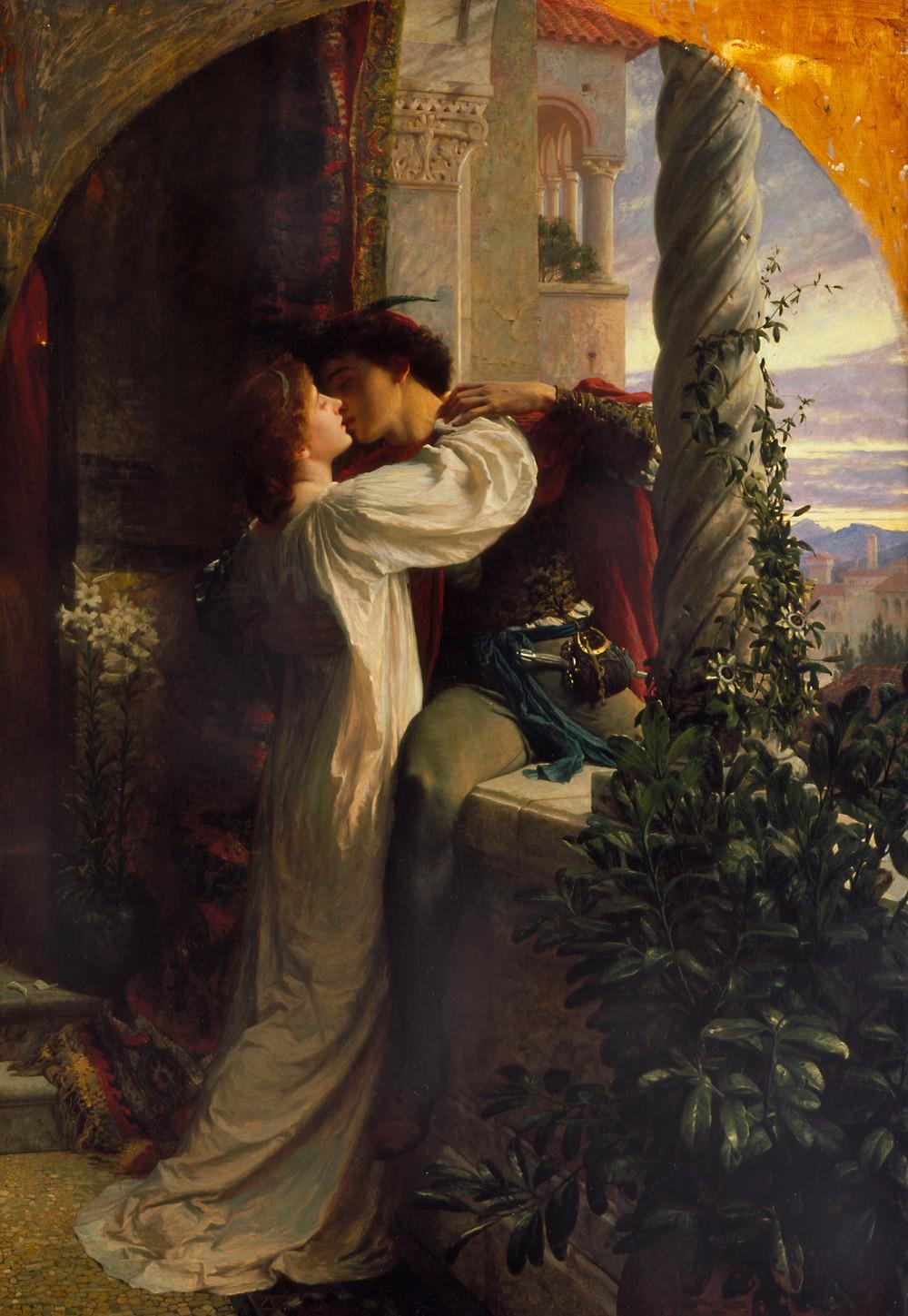
There is no balcony. The most famous scene in English drama is universally called the balcony scene, but the word balcony does not appear in the play, or anywhere in Shakespeare. The stage direction says only that Juliet appears "above," at a window. The English word balcony was first recorded in 1618, two years after Shakespeare died. The balcony was added by later stagings, and then by Verona itself: the Casa di Giulietta, which draws tourists by the busload, had its stone balcony attached in the twentieth century. Thousands of letters addressed to Juliet still arrive in Verona every year, and a club of volunteers answers every one.
How to read it
Read it in a day, the way it happens. The Folger Shakespeare Library offers the full text free online with every hard word glossed, which is the easiest way in. Project Gutenberg and Standard Ebooks have free editions for e-readers, and LibriVox has a free audio performance by volunteers. If you want to watch rather than read, the 1968 Zeffirelli film is the one most faithful to the play's youth, and the National Theatre and Globe have filmed productions available to stream. The painting above is by Frank Dicksee, a Victorian who painted the window scene in 1884; it hangs in Southampton City Art Gallery, and yes, he gave her a balcony.