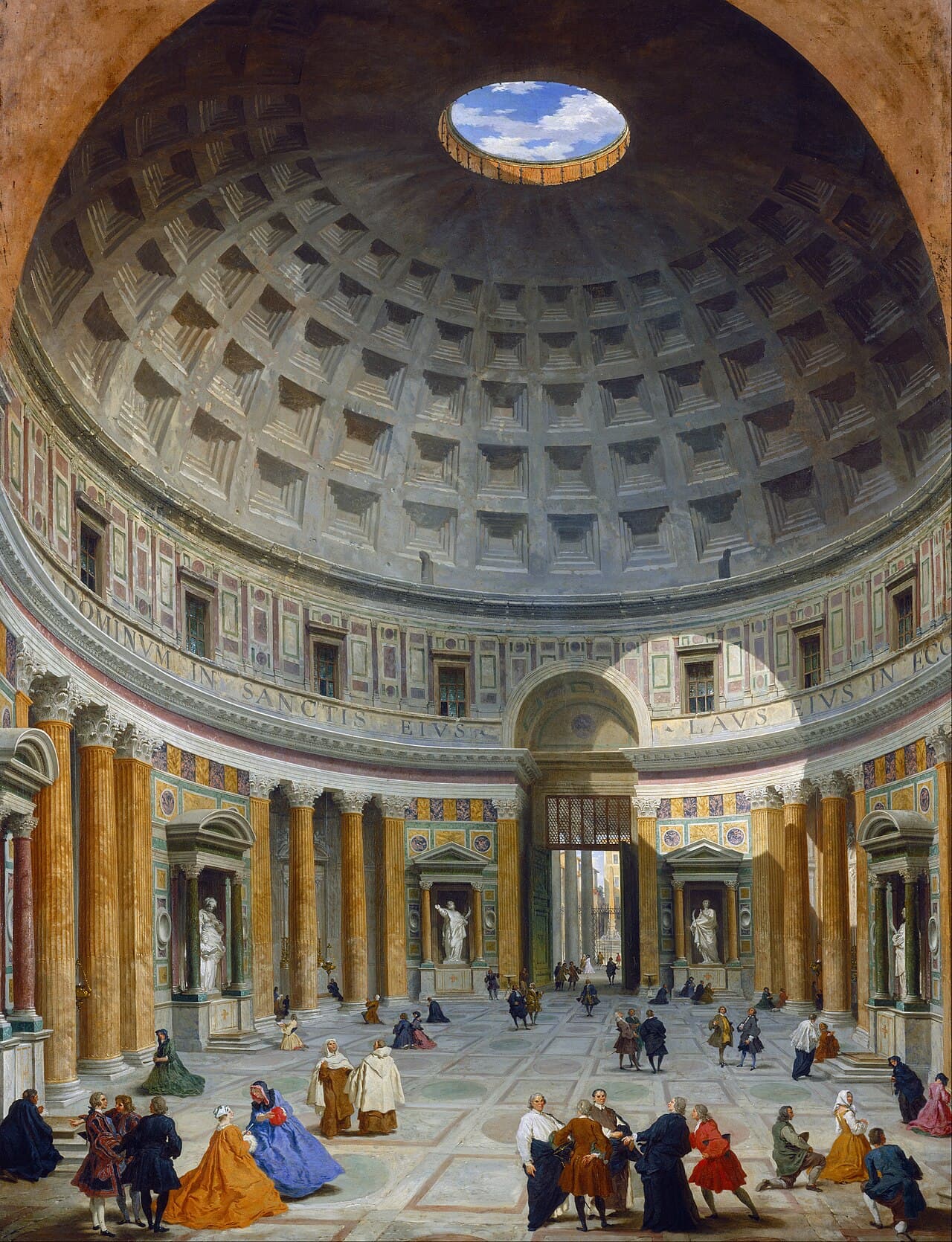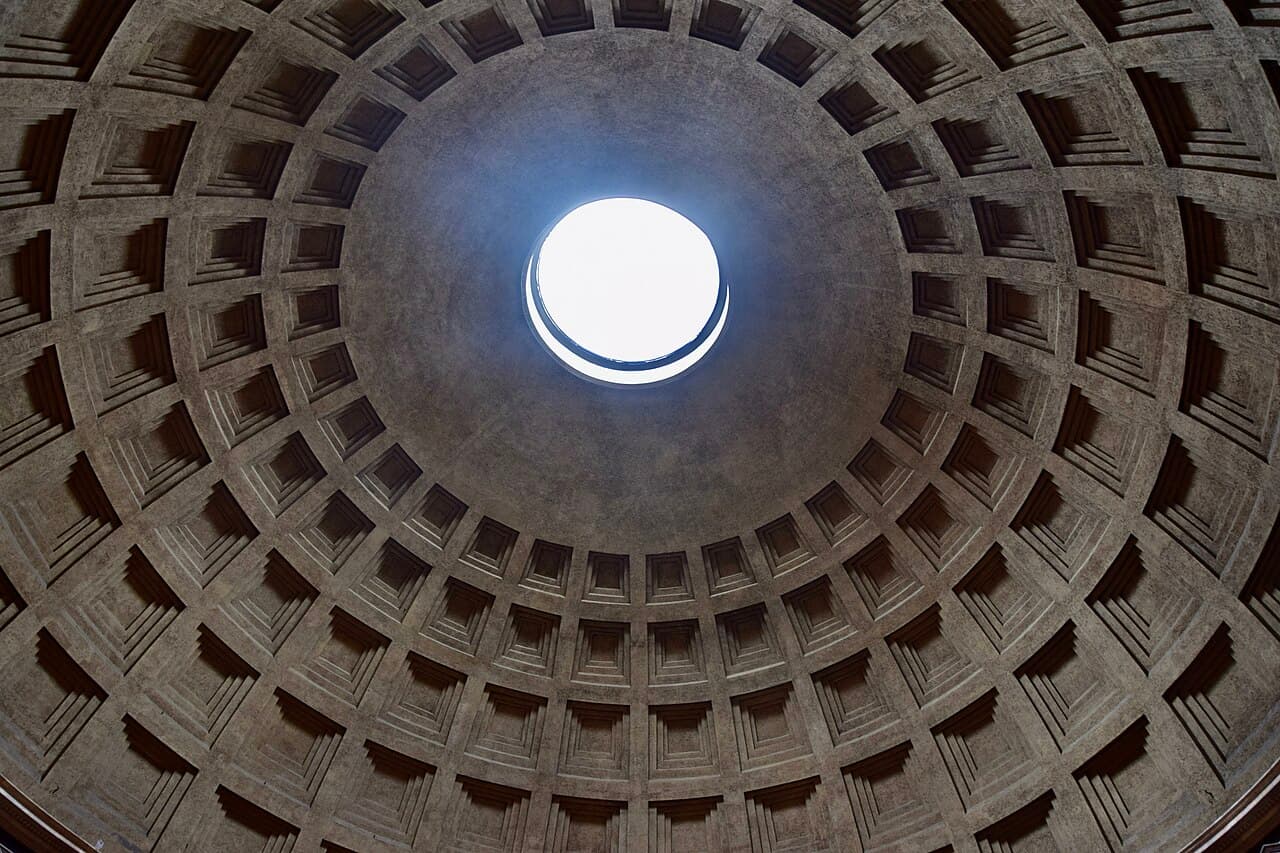
There is a moment that happens to almost everyone who walks in for the first time. You cross a heavy Roman porch, push past bronze doors, and the space opens: a single round room the size of a city square, capped by a grey dome that seems to float, with a circle of pure sky burning at its top. People stop mid-step. Two thousand years of visitors have stopped on the same stone.
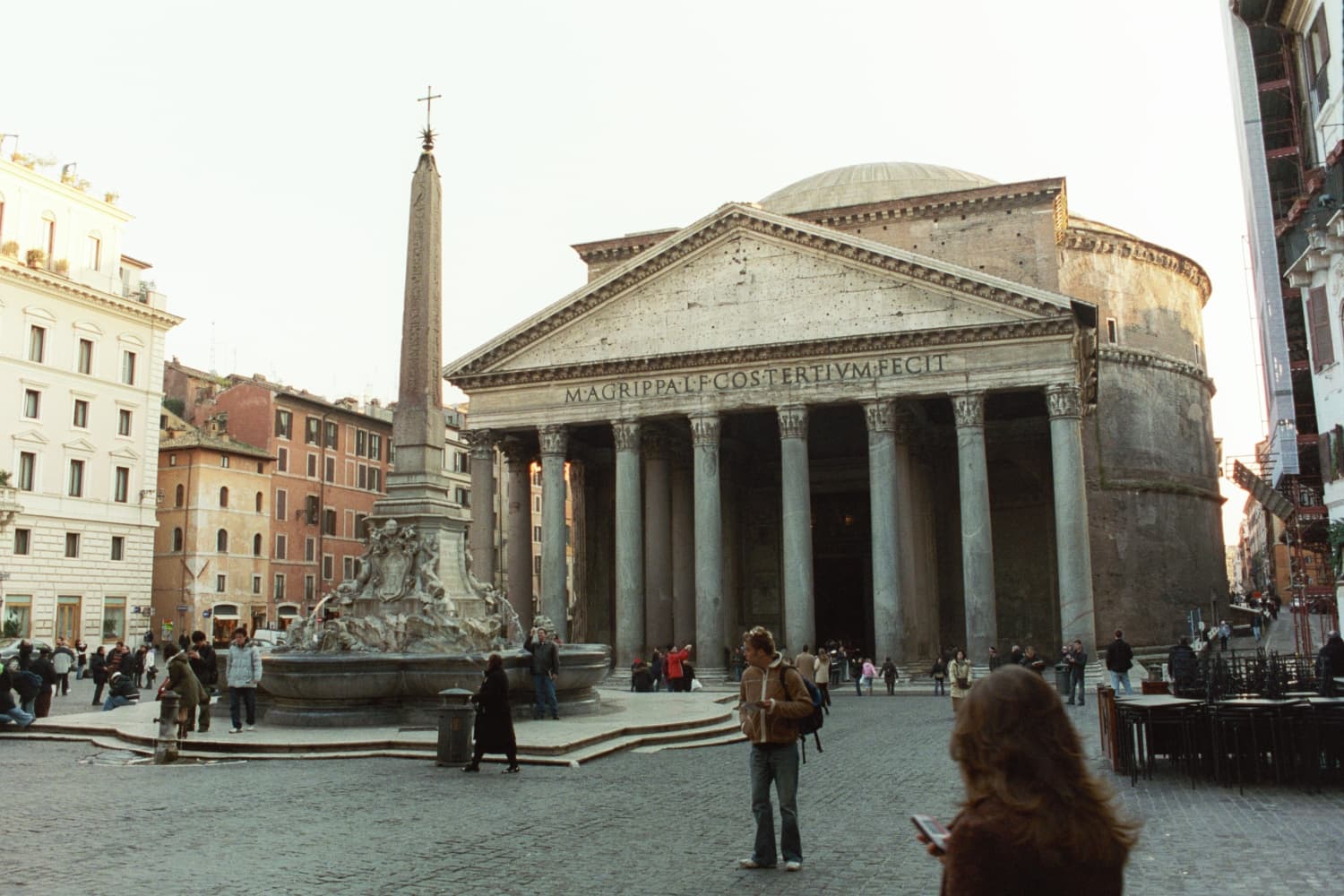
The Pantheon was completed under the emperor Hadrian around 126 AD, on the site of an earlier temple built by Marcus Agrippa, whose name still spans the porch in bronze letters, a two-thousand-year-old act of architectural courtesy. What it was exactly for, a temple to all gods, an imperial audience hall, remains debated. What it is, is the best-preserved building of ancient Rome, and still the largest unreinforced concrete dome on Earth.
What you're looking at
A cylinder of brick-faced concrete walls six meters thick, carrying a hemispherical dome 43.3 meters across. The geometry is exact: the dome's height equals its radius, so a perfect sphere would fit precisely inside the room. The ceiling is carved with five rings of sunken square panels, coffers, and at the crown, instead of a keystone, there is nothing at all: the oculus, nine meters of open sky.
What makes it special
The concrete is smarter than it looks. Roman engineers graded the recipe as the dome rises: heavy basalt in the foundations, brick and travertine in the walls, and near the top, feather-light volcanic pumice. The dome thins from six meters at its base to about 1.2 at the oculus. Modern engineers, with steel and computers, still study how a culture without either poured a dome they have never out-built in kind.
The hole is the genius. The oculus removes the dome's heaviest, most useless part and replaces it with light. Practically, it cuts weight where stress is lowest. Experientially, it turns weather into interior decoration: a column of rain in a thunderstorm, a wandering coin of sunlight on clear days, and on one April afternoon a year, sun aligned squarely on the entrance door. The building's flaw is its feature; its emptiness is the design.
It never fell out of use. Almost every ancient building you know is a ruin, quarried for its marble and its memory. The Pantheon was converted into a church in 609 AD, which saved it: continuously roofed, repaired, and occupied for nineteen centuries. The bronze that once lined the porch beams was stripped by a seventeenth-century pope, prompting Rome's most durable joke: what the barbarians did not do, the Barberini did.
The story behind it
Its afterlife is a history of architecture by itself. Brunelleschi studied it before daring the dome of Florence's cathedral; Michelangelo is said to have called such work angelic rather than human design; Raphael chose to be buried in it, and lies there now beneath his epitaph. Jefferson's University of Virginia rotunda, countless capitol buildings, and practically every domed bank lobby on Earth are its descendants. For five hundred years, the polite way for an architect to say masterpiece has been to quote this room.
One detail most people miss
Look down, not up. The marble floor, still substantially the ancient one, is not flat: it swells gently toward the center and is pierced by small drain holes under the oculus. The Romans did not fight the rain; they scheduled it. A building with a hole in its roof has stayed dry-shod for two millennia by the oldest trick in engineering: accept the problem, then slope the floor.
Where to see it
Rome, Piazza della Rotonda, a short walk from Piazza Navona. Entry is now ticketed but modest; go when it rains if you possibly can, stand at the edge of the wet circle, and watch a two-thousand-year-old building perform its original special effect.