Walk into room 12 of the Prado in Madrid and you will find a crowd standing in front of a very large canvas, doing something slightly unusual for a museum: they are not just looking at the painting. They are trying to work out where they are standing. Because the painting seems to know you are there.
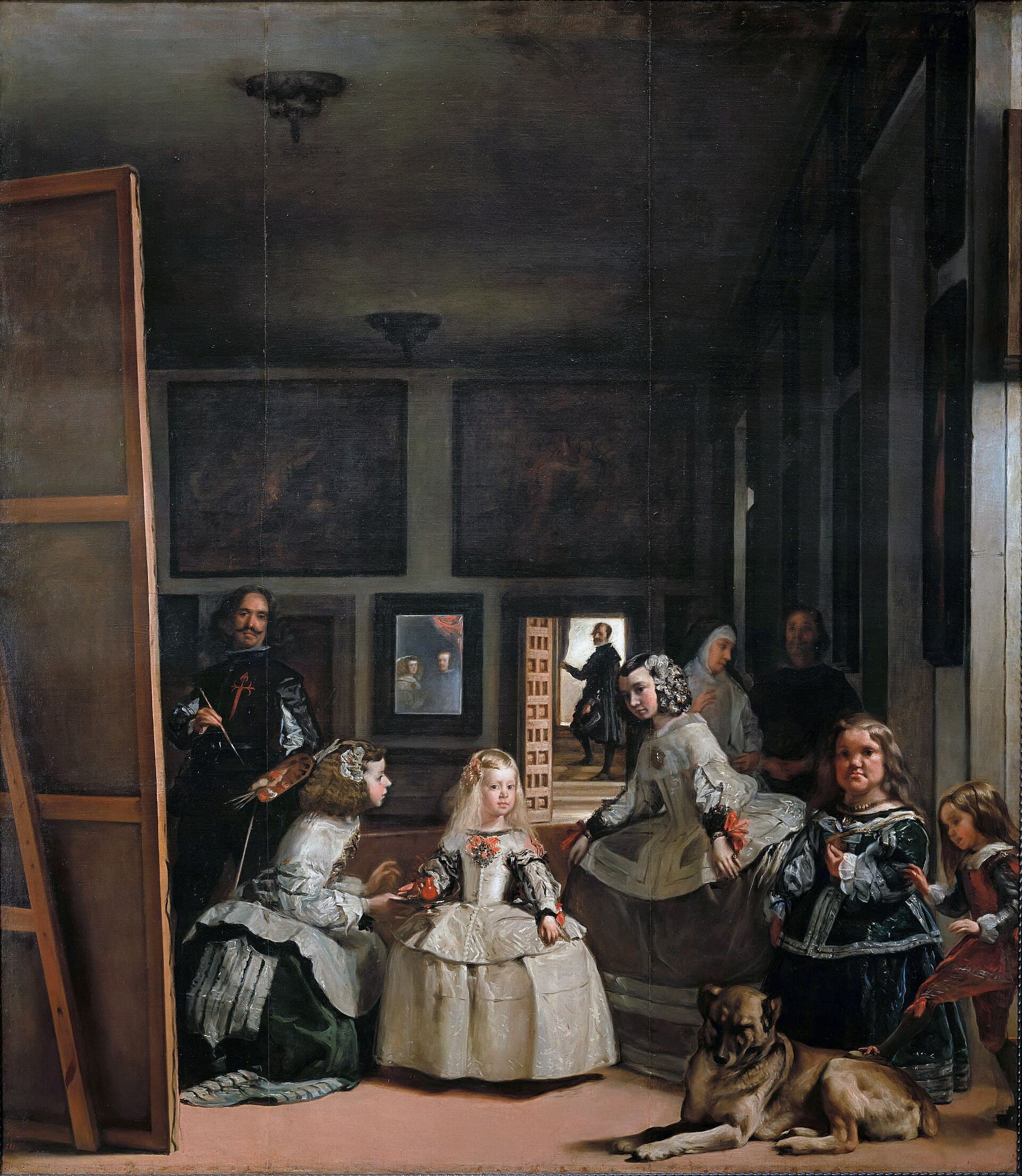
Las Meninas shows a room in the royal palace of Madrid in 1656. The five-year-old princess Margarita stands in the center, lit like a small sun, attended by her maids of honor - the meninas of the title. Around them: two dwarfs, a large sleepy dog, a chaperone, a bodyguard, and a man in a doorway at the back, caught mid-step on a staircase. On the left, at a huge canvas we see only from behind, stands Velázquez himself, brush in hand, looking directly out of the picture. At you.
What you're looking at
The scene feels like a snapshot: a moment of palace life interrupted. But look at the back wall. In the dim mirror hanging there, two faces shimmer - King Philip IV and Queen Mariana. They are standing, apparently, exactly where you are standing. Suddenly the picture reorganizes itself: perhaps Velázquez is painting the royal couple, the princess has wandered in to watch, and everyone is reacting to the king and queen - which means everyone is reacting to you.
What makes it special
Nobody can settle what it shows. Is Velázquez painting the king and queen, reflected in the mirror? Or is the mirror reflecting the canvas he is working on? Art historians have argued both, with diagrams, for generations. The philosopher Michel Foucault opened an entire book with this painting, calling it a picture about the act of representation itself.
It reverses the rules of portraiture. The actual monarchs, the most powerful people in Spain, appear only as a blur in a mirror, while servants, dwarfs, and a dog get the full light. The painter Luca Giordano called it "the theology of painting" - the moment painting started thinking about itself.
The brushwork is a magic trick. Up close, the maids' dresses dissolve into loose, almost careless smears. Step back, and silk appears, shimmering. Velázquez painted not the things themselves but the way light reports them to your eye, two centuries before the Impressionists made that idea a movement.
The story behind it
Velázquez was not a court decorator; he was a courtier who painted. He spent decades climbing the palace hierarchy of Philip IV, eventually running the king's art collection and his ceremonies. What he wanted most was noble status - specifically, admission to the Order of Santiago, which required proving you did not work with your hands. An awkward requirement for a painter.
He got his knighthood in 1659, one year before his death, after a papal dispensation. And here is the detail people love: the red cross of Santiago sits on his chest in Las Meninas, painted onto a picture finished three years before he received the honor. Legend has it the king himself ordered it added after the painter's death - some tellings say Philip painted it with his own hand. There is no proof, but the story has survived because it fits: the painting was always about the strange intimacy between a king and his painter.
Picasso took the painting personally. In 1957 he locked himself in a villa and painted 58 variations of Las Meninas, dissecting it like a puzzle he could not put down.
One detail most people miss
The man in the lit doorway at the back is José Nieto, the queen's chamberlain. He is the only figure who could leave the room, and he pauses, curtain in hand, looking back - a second exit for your eye, and a quiet question: is he arriving, or leaving? The painting does not say. It never says.
Where to see it
Museo del Prado, Madrid, where it has hung since the museum opened in 1819. It is never loaned. To see it, you go to it - which, for a painting about presence, feels exactly right.