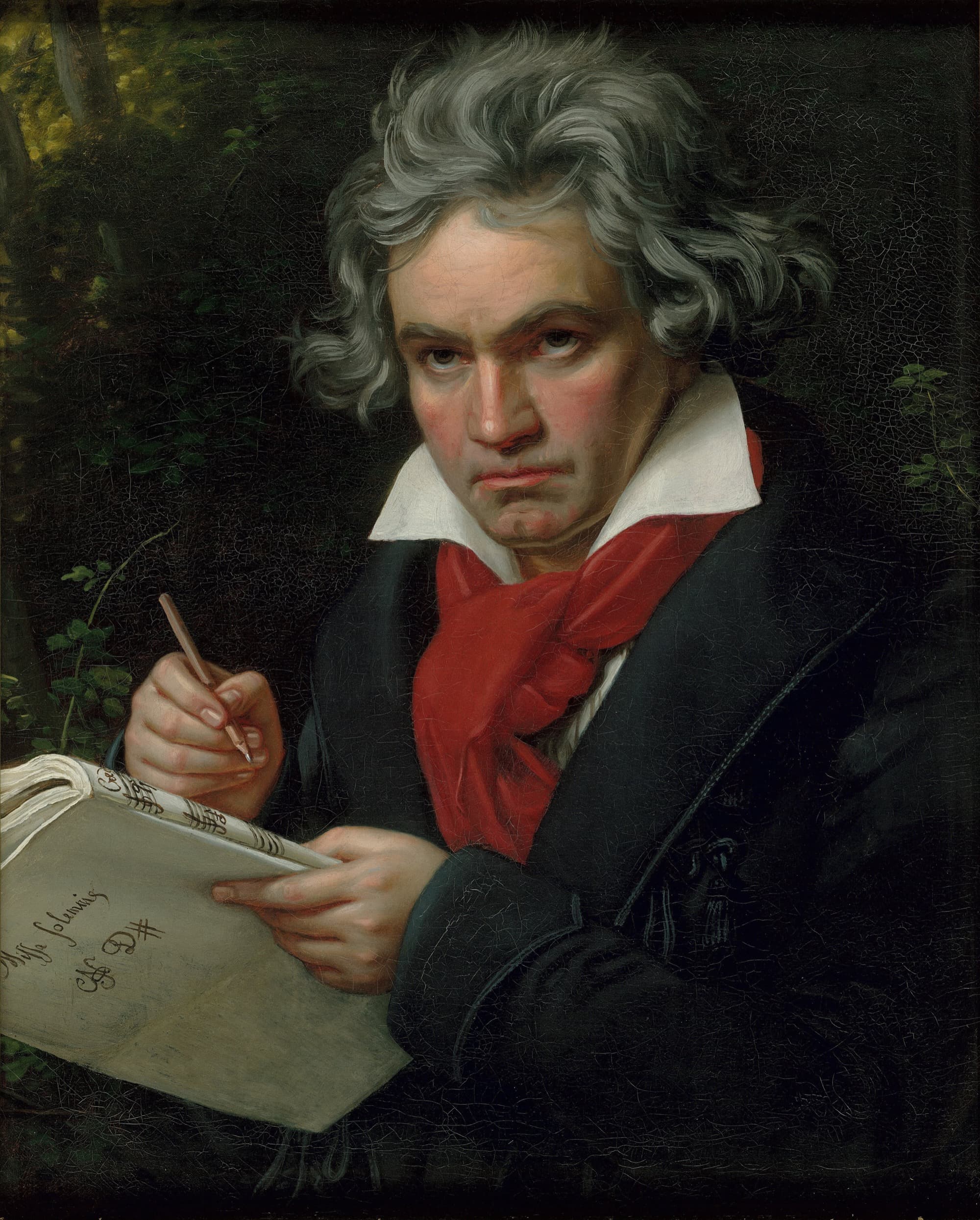
When Beethoven's Ninth Symphony was first performed in Vienna in 1824, its composer was standing on the stage, turned toward the orchestra, beating time to music he could not hear a single note of. He was by then almost completely deaf. At the end of the performance, with the audience behind him erupting into a roaring ovation, he kept facing the players, unaware, until one of the singers gently took his arm and turned him around so he could see the applause he would never hear.
That is the impossible fact at the center of the most joyful music ever written. The man who gave the world its great anthem of happiness and human brotherhood composed every note of it inside a silent head.
What you're listening to
The "Ode to Joy" is the grand finale of Beethoven's Symphony No. 9, his last complete symphony. After three movements of orchestra alone, something unheard-of happens: the music breaks into human voices. Four solo singers and a full chorus rise up to sing words from a poem by Friedrich Schiller, a hymn to joy and to the idea that all people, everywhere, are brothers. The melody they sing is one of the simplest and most recognizable tunes on Earth, and it has been borrowed for everything from films to football stadiums to the official anthem of Europe.
What makes it special
A symphony suddenly starts to sing. For centuries, a symphony meant instruments, full stop. Beethoven shattered that rule by bringing a choir and soloists into the finale of a symphony for the first time on this scale. It was as if a painter had reached the edge of the canvas and simply kept going onto the wall. Audiences had never experienced anything like it.
The tune was built so anyone could sing it. The Ode to Joy melody moves almost entirely in small steps, note to neighboring note, with no difficult leaps. It sounds inevitable, like a tune that had always existed and Beethoven merely found. That plainness is the point: a song of universal brotherhood had to be singable by everyone, not just trained musicians.
It was written by a man who could not hear it. Beethoven composed the entire work in deafness, hearing it only in his imagination. The sheer joy of the music is, in that light, almost defiant, an act of faith in sound by someone cut off from it.
The story behind it
Beethoven had wanted to set Schiller's poem "An die Freude," written in 1785, to music for decades before he finally found the way, inside this symphony. The 1824 premiere, with the deaf composer on stage, became one of the most famous nights in the history of music. The Ninth went on to change what a symphony could be, casting a long shadow over every composer who came after. In 1972 its main melody was adopted as the Anthem of Europe, in an instrumental arrangement, and it remains a shared musical symbol of unity across the continent.
One detail most people miss
Everyone remembers the enormous choral blast of "Freude!" But listen to how the famous melody actually arrives. It does not crash in. It creeps in quietly, played first by the lowest, humblest instruments in the orchestra, the cellos and double basses, alone and almost bare. Then it is passed upward, gathering instruments and strength with each repetition, swelling through the orchestra long before any voice sings a word. Beethoven builds the biggest tune in the world up from a whisper, and most listeners never notice the hush it starts in.
How to listen
Press play above for a beloved public performance of the Ode to Joy, where a street slowly fills with musicians and a crowd. Then, to hear the real scale of it, find a complete recording of the Ninth Symphony's finale by a great orchestra and chorus, such as the Chicago Symphony under Riccardo Muti. Listen first for that quiet, low entrance of the theme in the cellos and basses, and then let it carry you up to the moment the voices finally break through.