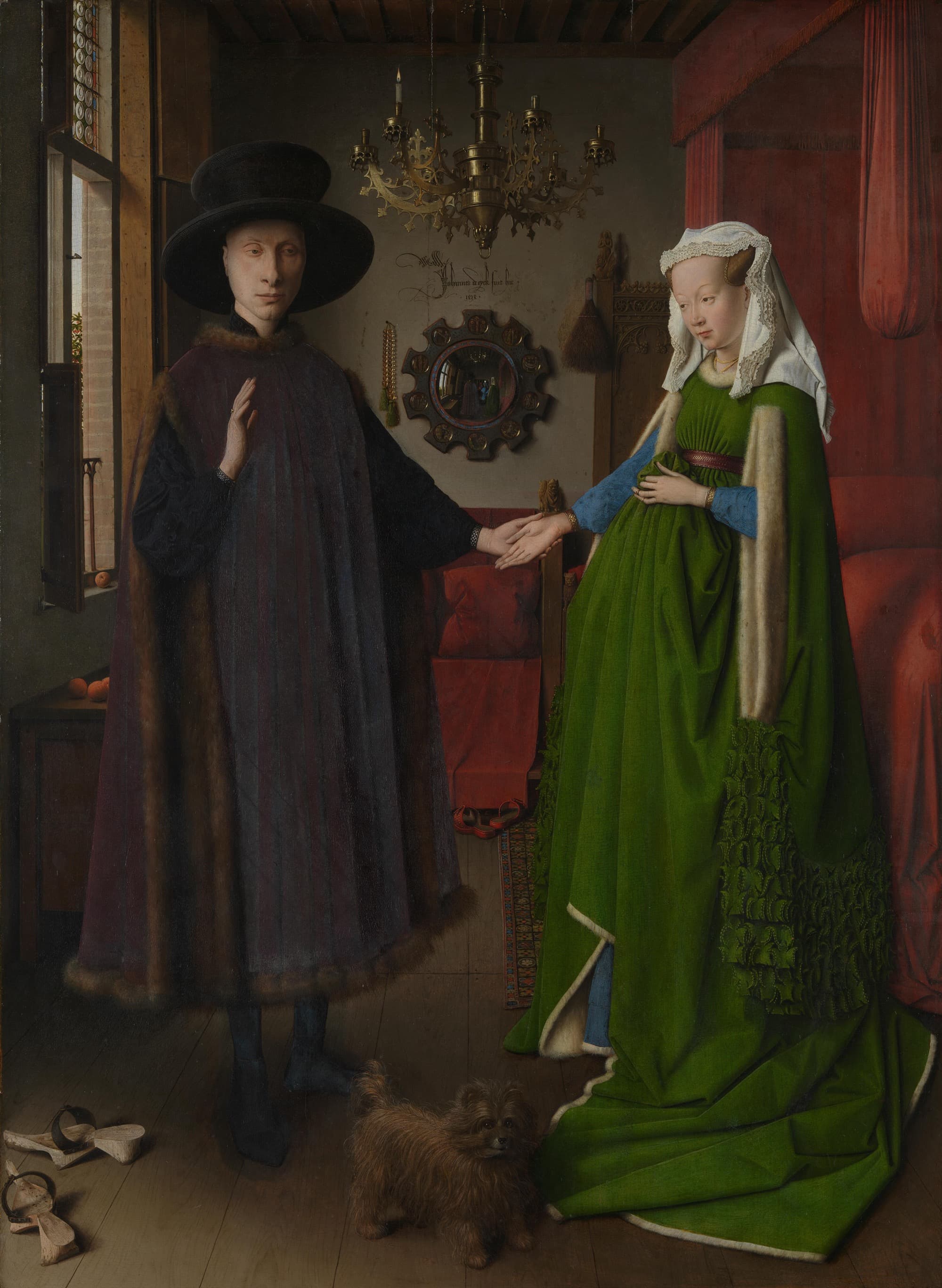
On the back wall of this small room hangs a round, convex mirror no bigger than a saucer. Lean in and look at it, and you can see the entire scene reflected from behind: the backs of the couple, the window, and, impossibly, two more tiny figures standing in the doorway, exactly where you, the viewer, are standing. One of them may be the painter himself. And just above the mirror, in curling formal script, van Eyck wrote a line that still gives people a small shiver: "Jan van Eyck was here, 1434."
Not "painted by," but "was here," as if he were a witness signing a legal document. Almost six hundred years later, we are still arguing about what, exactly, he witnessed.
What you're looking at
A wealthy couple stands in a comfortable bedroom, holding hands. He is traditionally identified as Giovanni Arnolfini, an Italian merchant living in the booming trade city of Bruges, in what is now Belgium; she is thought to be his wife. They are dressed in expensive fur-trimmed clothing, surrounded by signs of money and status. Everything is rendered with hallucinatory precision: the brass chandelier, the oranges on the sill, the folds of green wool, the little dog at their feet. It was painted in 1434 by Jan van Eyck, one of the greatest and earliest masters of oil painting.
What makes it special
It shows what oil paint could suddenly do. Van Eyck did not invent oil paint, but he pushed it further than anyone before him. By building up thin, transparent layers, he achieved a depth and glow, and a level of fine detail, that earlier methods could not match. Metal gleams, fur looks soft, glass looks like glass. This painting is a demonstration of a new technology at full power.
Every object may be a message. For a long time scholars read the room as a code: the single lit candle as the eye of God, the dog as fidelity, the discarded shoes as standing on holy ground, the whole picture as a kind of marriage certificate. Not everyone agrees anymore, but the sense that nothing here is accidental, that the room is quietly speaking, is part of its spell.
The painter put himself inside it. The mirror and the "was here" inscription fold the artist into his own picture, as a reflection and a witness. It is a strikingly modern move, a painter signing not just his name but his presence, standing in the same doorway as you.
The story behind it
Bruges in the 1400s was one of the richest trading cities in Europe, and van Eyck was its star painter, working for the powerful Duke of Burgundy. Portraits like this were luxury objects for a new merchant class with money to spend on proving its status. The popular idea that the woman is pregnant is almost certainly wrong: she is simply gathering up a heavy, fashionable gown in the style of the day. What the painting actually commemorates, a wedding, a betrothal, a memorial, remains genuinely uncertain, which is part of why it has fascinated people for centuries.
One detail most people miss
Look at the frame of that little mirror. Set into it are ten tiny roundels, each one a miniature scene from the Passion of Christ, his suffering and death. They are painted so small you can easily miss them entirely, yet each is a complete picture in its own right. It is a quiet show of impossible skill: having already fit a whole reflected room into a saucer-sized mirror, van Eyck then ringed it with ten more paintings barely larger than grains of rice.
Where to see it
The Arnolfini Portrait hangs in the National Gallery in London, where entry is free. It is smaller than you expect, which makes the density of detail even more astonishing in person. Get as close as you are allowed, find the mirror, and look for the reflected figures in the doorway and the line of script above it. You are standing roughly where van Eyck stood, reading the note he left to say that he, too, was here.