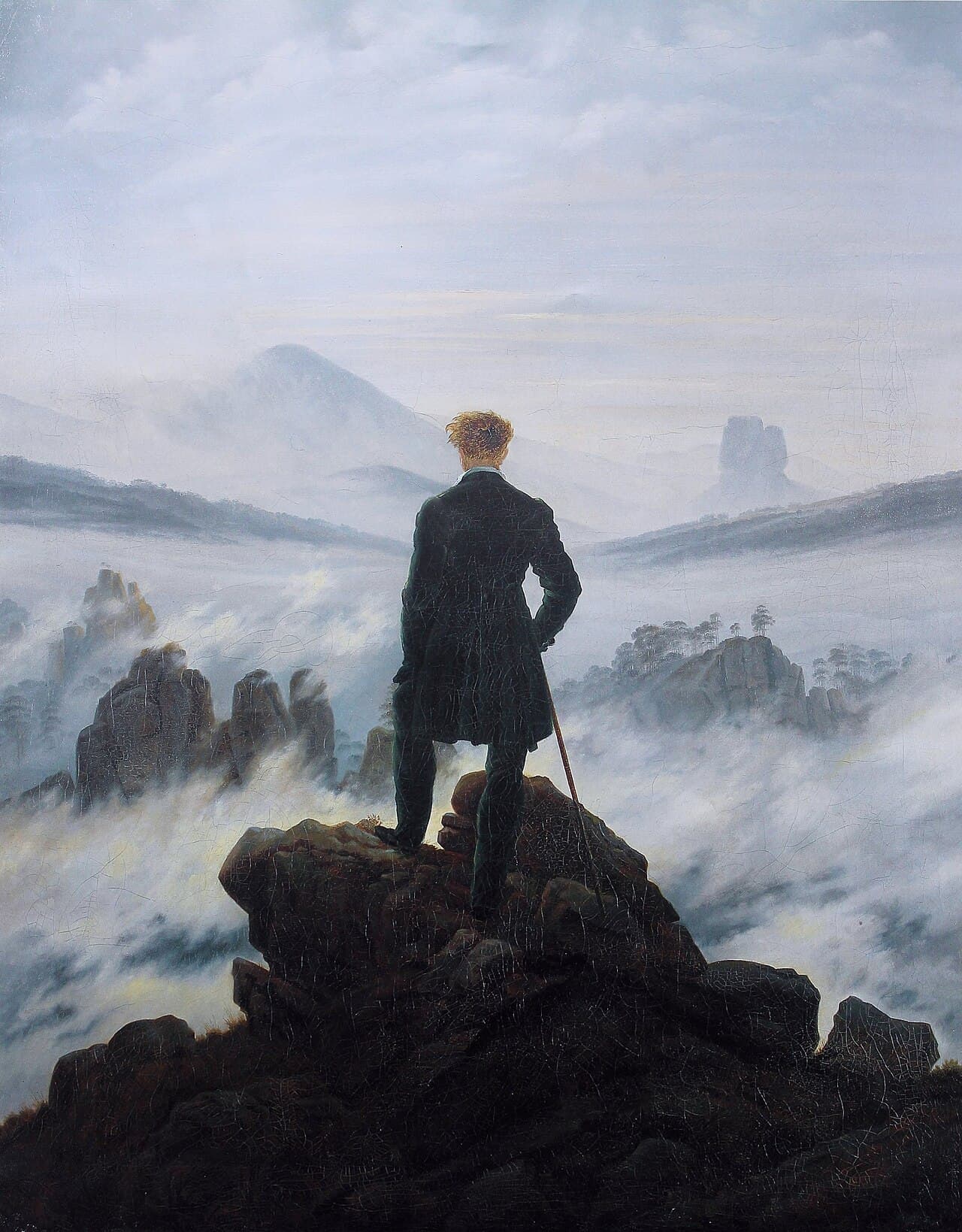
A man stands on a rocky peak, one leg up like a conqueror, walking stick planted, hair in the wind. Below him, an ocean of fog swallows the valleys, with mountain ridges surfacing like islands. He has climbed above the world, and he is completely alone. You cannot see his face. You do not need to: standing behind him, looking with him, his silence becomes yours.
Caspar David Friedrich painted this in 1818 in Dresden, and it has become the definitive image of Romanticism, the movement that decided nature was not scenery but a mirror: the outer landscape as a picture of the inner one.
What you're looking at
A young man in a dark green coat, city clothes, not hiking gear, on a sandstone outcrop. The peaks around him are real: Friedrich sketched them separately in the Elbe Sandstone Mountains near the Bohemian border, then assembled them into a landscape that exists nowhere. The fog does the compositional work, hiding every path, every village, every trace of other people. The world has been simplified into a man, rock, and infinity.
What makes it special
The composite landscape is a confession. Friedrich did not paint a view; he built one from pieces, the way memory does. Each ridge is accurate, the whole is invented. That is Romanticism's core move: truth to feeling over truth to geography. The painting shows what standing on a summit feels like, which no faithful panorama ever quite does.
It captures a feeling nobody had named. Triumph? He has conquered the peak. Loneliness? He is a small dark figure against an indifferent vastness. Longing? The fog hides everything he cannot reach. The Germans have a word, Sehnsucht, an ache for something unnameable, and this is its official portrait. The painting works because it refuses to pick one emotion.
It is the ancestor of a billion photographs. Every hiker photographed from behind facing a view, every album cover with a figure staring into mist, every movie hero contemplating the horizon: the visual formula starts here. When you pose someone looking away from the camera at a landscape, you are quoting Friedrich, whether you know it or not.
The story behind it
Friedrich was a solitary, melancholy northerner who walked constantly and talked little; at seven he lost his mother, and at thirteen he watched his brother fall through lake ice and drown while saving him. Critics of his day found his paintings strange and his popularity faded badly; he died poor in 1840, nearly forgotten. The twentieth century resurrected him, and not always kindly: his imagery was later exploited for nationalist propaganda he never asked for, then reclaimed again by museums and by book covers, film posters and metal albums. The painting has been famous for barely a hundred years. It feels eternal.
One detail most people miss
Look at where the rocks under his feet actually sit in the composition: the outcrop rises from the bottom edge like a pyramid, and his head is placed almost exactly at the painting's center, higher than every distant peak. Friedrich quietly redrew the mountains so that a single human mind stands taller than the landscape. That is the entire Romantic movement in one compositional decision.
Where to see it
The Hamburger Kunsthalle in Hamburg. It is smaller than its fame suggests, and the room is usually crowded with people photographing it, mostly from behind other visitors, everyone unintentionally reenacting the painting they came to see.