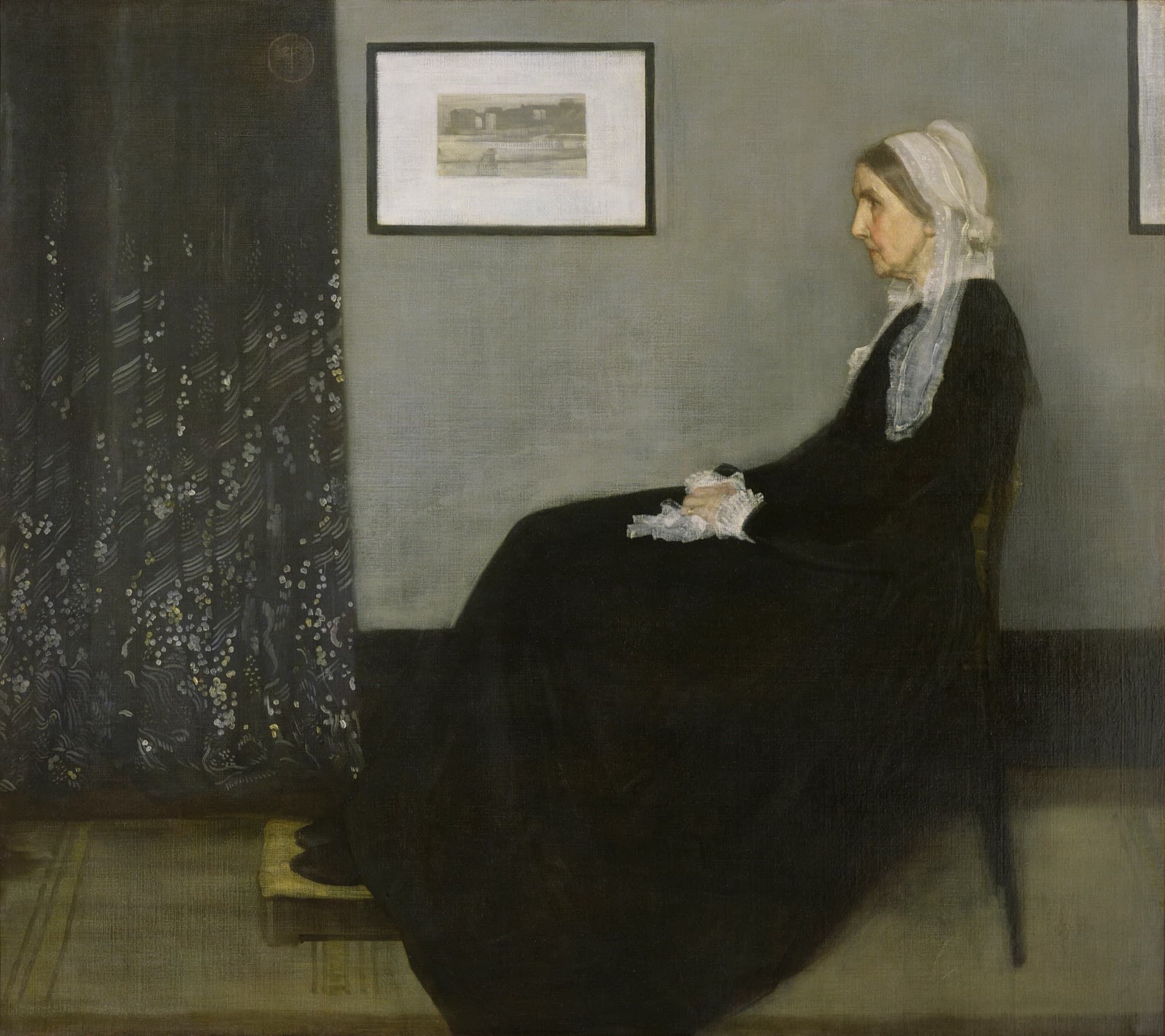
The real title of the most famous painting of motherhood in history is Arrangement in Grey and Black No. 1. Not "My Mother," not "A Mother's Love." An arrangement, like a piece of music, of two colors. Whistler meant exactly that. "To me," he wrote, "it is interesting as a picture of my mother; but what can or ought the public to care about the identity of the portrait?"
He wanted you to look at the balance of dark shapes against grey, the way a composer wants you to hear the notes. It just so happened that the figure holding the whole composition together was his own elderly mother, who, by one account, was sitting in only because another model had failed to turn up.
What you're looking at
An old woman sits in profile, facing left, still and composed. She wears a plain black dress and a white cap and holds a handkerchief in her lap. Around her, Whistler arranges a careful field of greys: a grey wall, a dark curtain patterned at the edge, a framed print, a hint of baseboard. Her name was Anna McNeill Whistler, the painter's mother, and the picture now hangs in the Musée d'Orsay in Paris. Everything in it is subdued, flattened, and quiet, built from a narrow range of tones.
What makes it special
It argues that a painting does not need a subject. Whistler was a leading voice for art for art's sake, the idea that beauty and composition are reason enough for a picture to exist. By naming it an "arrangement" and downplaying the sitter, he was making a statement: judge this by its shapes and colors, not by sentiment or story.
It is built like a flat design. Notice how little depth there is. The figure, the framed picture, the curtain, and the wall read almost like panels laid side by side, a balance of rectangles with the dark mass of the seated woman anchoring the left. This near-abstract flatness, influenced by Japanese prints Whistler loved, points ahead toward modern art.
The restraint is the feeling. There is no drama, no smile, no narrative. Yet the stillness and the muted color carry a quiet dignity and a trace of melancholy. Whistler tried to drain the sentiment out, and a different, cooler emotion seeped back in anyway.
The story behind it
Whistler was an American who lived in London and Paris, famous for his wit, his feuds, and his dandyish style. He fought a notorious libel battle with the critic John Ruskin, who accused him of "flinging a pot of paint in the public's face." Whistler won the case but only a token penny, and the cost helped bankrupt him. The portrait of his mother, slow to find admirers at first, was eventually bought by the French state in 1891, a major honor, making it one of the first works by an American painter to enter a great national museum.
One detail most people miss
The world refused to accept Whistler's cool, formal title. Over the decades the painting was swallowed up by exactly the sentiment he tried to avoid, and it became a universal symbol of motherhood, devotion, and old age. In 1934 the United States even put it on a postage stamp, with the words "In memory and in honor of the mothers of America," turning an anti-sentimental "arrangement" into the ultimate Mother's Day card. It is one of art's great ironies: Whistler told everyone to stop caring who she was, and instead they made her everyone's mother.
Where to see it
Whistler's Mother lives at the Musée d'Orsay in Paris, among the Impressionists and their contemporaries. Stand back and let it work as Whistler wanted, as a balance of dark and grey, then step closer and let the old woman reassert herself. The painting holds both truths at once: a cold experiment in color, and the most tender portrait of a mother the world has ever adopted.